Individual Reflection – a conversation style piece:

Giving a “Voice” to Students Who Have No Voice

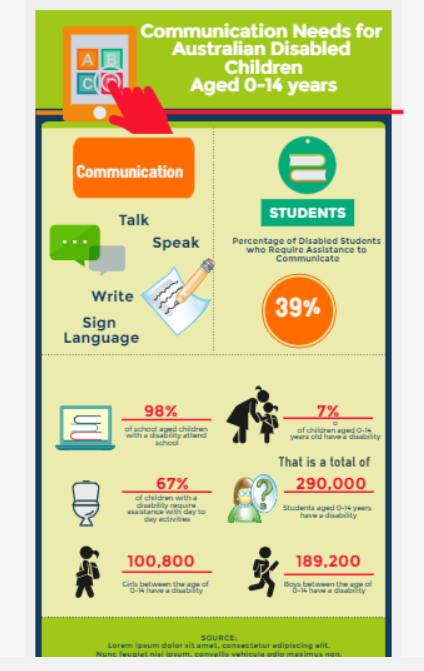
Communication is something that we do every day. Something that lot of us take for granted.  However, for many students with a disability, this is a major stumbling block.  Imagine a world where you could not speak? Could not write? Could not express an opinion?  “Not being able to speak is not the same as having nothing to say” (Assistiveware, 2019). Did you know that 39% of all disabled children aged between 0-14 years of age in Australia, require assistance to communicate? That is approximately 113,000 children aged 0-14 in Australia.  However, there is good news, due to technology advancement, many students now can have a voice or a way to communicate with others.
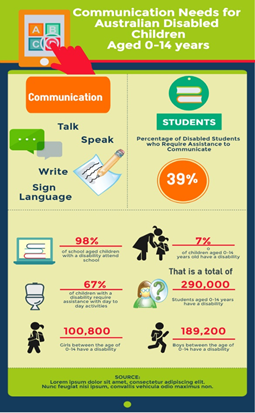
Communication Needs for Australian Disabled Children Aged 0-14 years

What is communication?   All humans have the right to communicate.  We communicate in a variety of different ways.  We speak, write, make gestures, use facial expressions, pictures and even use online social technologies such as Twitter and Facebook.  Communication is a two-way interaction requiring a sender and at least one receiver, and occurs all day, every day, and impacts our quality of life.  It is a way in which we share our joy and sadness, our needs and wants, to learn and demonstrate our knowledge to even feeling a sense of belonging through sharing stories and information (McMillan and Raghavendra, 2013).  “Communication is the essence of human life (ASHA, 1991, p. 9). For the classroom, it is also fundamental in literacy development and enables students to participate in their education (Niemeijer & Farrall, 2015). 

All teachers will tell you that students in today’s classroom are a diverse group of learners.  A typical classroom requires a student to read, speak, write, drawn, listen and understand the teaching.  So how can a student who can not speak or write participate in learning on the same basis as other students?  The Disability Standards for Education 2005 highlights that considerations are made in the way of ‘reasonable adjustments’ to ensure that students with disability are provided with opportunities to participate on the same basis as students without disability (ACARA, 2017).  Technology developments are helping to provide answers to help such students to communicate with the use of augmentative and alternative communication (AAC).

Augmentative and alternative communication (AAC) is a type of communication system that attempts to compensate for those with severe difficulties with speech and language expression (McMillan and Raghavendra, 2013). The first “A” in AAC stands for Augmentative, which is defined as making something greater by adding to it. So augmentative communication is when speech is supplemented with something, for example, signs, symbols or a letter board to make the message clearer to the audience.  The second “A” stands for Alternative Communication.  This is when the person is not able to speak, or your speech is not understandable even when something is added to it. In this case, there is a need to communicate is a different way.

I will focus on students who cannot speak, who are classified as having complex communication needs (CCN). In many cases, these students also are not able to read or write. The first step of using an AAC is introducing pictures that represent words or phrases. Students must understand that a picture has a certain meaning.   There is a wide range of AAC technologies available, and each device is selected with the needs and the capabilities of the end user in mind.   Today I will focus on one AAC device, called Proloquo2Go. Proloquo2Go is an app that can be used on an iPad, iPhone or iPod touch and can be used as a daily communication tool (Assistiveware, 2019).  That is right, an app, not an expensive computer that costs an astronomical amount, but an app that can be applied to a device that is found in most modern homes.
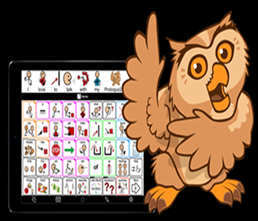
Proloquo2Go by Assistiveware
(AssistiveWear, 2019)

This app is designed to be customised to suit the user. The aim is to allow the user to use their words, their way (Assitiveware, 2019).  From the selection of vocabulary to the appearance and even voice used. There are over 25,000 symbols to use, or a personal photo can be added to represent things, people and places.  What is so fabulous about this app is that it gives the person a voice using a speech generated device (SGD) called text to speech voice (McMillian and Raghavendra, 2013). This allows communication to be more typical, which reduces communication breakdowns (McMillian and Raghavendra, 2013). The user can choose a voice to represent themselves.  This is made possible by using real voices, including a range of different accents, making them sound surprisingly natural (Assistiveware, 2019).  For example, the user can choose an Australian female child’s voice (developed in 2013).  Wow, can you imagine going from no voice to being able to sound just like your peers?  How fantastic.

Below is a video clip from Assistivewear (2019) on how they have used real children voices:

https://www.assistiveware.com/innovations/creating-genuine-childrens-voices

The majority of student’s education is about communication, comprehension and expressing of information, ideas and concepts. AAC devices such as Proloquo2go, have started to allow students who are non-verbal, to participate and engage in the learning. This also enables these children to engage with their peers by having a voice. Below is a video of a classroom with Tyrone, Alana and Andrew – all Proloquo2Go AAC users, using this device to advance their communication skills (AssistiveWare, 2013). Watch the students as they talk with each other, share experiences, interact with their teacher and learn.

Proloquu2Go – Communication is Conversation.
(Assistiveware, 2013)

From my experience, many people who have no experience with non-verbal individuals, believe that the person has nothing to say.  In reality, this far from the case.  I am a mother of a non-verbal nine-year-old daughter, Jasmine.  She has never been able to speak.  My daughter is not currently capable of using this app as she does not have the fine motor skills, however we a working towards this goal.  Jasmine like everyone else has a right to communicate, to be heard, to have ‘a voice’.  What a wonderful world, where through technology advancements that a personal device and an app can help people to do this.  I am excited for the prospect of further technology developments that can assist those with a disability have a full and active part in our community. Non-verbal people might not have a voice of their own, but I can assure you, they do have a lot to say.

References:

American Speech-Language_Hearing Association (ASHA). (1991). Report augmentative and alternative communication. ASHA, 33 (suppl. 5), 9-12.

AssistiveWare. (2019). Speak up with symbol-based AAC. Retrieved 17th May 2019 from https://www.assistiveware.com/products/proloquo2go

Assistiveware. (2019). Creating genuine children’s voices. Retrieved 21st May 2019 from https://www.assistiveware.com/innovations/creating-genuine-childrens-voices

Assistiveware. (2019).The Making of the new British children’s voices Harry and Rosie. Retrieved 21st May 2019 from https://www.assistiveware.com/innovations/creating-genuine-childrens-voices

Assistiveware. (26th November 2013). Proloquo2Go – Comminication is Convesation. Retrieved 21st May 2019 from https://www.youtube.com/watch?v=m9t-_iYuO4M

Australian Bureau of Statistics (ABS). (2009). Disability, Australia, 2009. Retrieved 10th May 2019 from https://www.abs.gov.au/ausstats/abs@.nsf/mf/4446.0

Farrall, j and Niemeijer, D. (2015).An overview of the Do’s and Don’ts of AAC.  AssistiveWare.  Retrieved 17th May 2019 from https://www.assistiveware.com/blog/overview-dos-and-donts-aac

Howell, J. (2014). Teaching & learning: Building effective pedagogies. Melbourne: Oxford University Press.

McMillan, J. and Raghavendra, P. (2013). Meeting Complex Communication Needs in the Classroom. In: M. Hyde, l. Carpenter and S. Dole, ed., Diversity Inclusion and Engagement, 3rd ed. Melbourne: Oxford.
Technology Challenge 9: Representing Data through Infographics

How to make vast amounts of data easily read and understood by an audience? With the use of infographics. Infographics enable complex data to be effectively communicated due to its visual format, making it easier for the viewer to draw conclusions.

I personally did not realise the impact of infographics on the intended audience until now. Probably because I had never had experience with infographics. “The Value of Data Visualisation” by Column Five states the importance of a good infographic combines both data and design. This clip emphasises the use of colour, size, flicker. All essential parts of designing, which draw the attention of the audience. All essential parts of designing, which draw the attention of the audience.

The Value of Data Visualisation by Column Five

Links to the Australian Curriculum: Foundation to Year 2: Digital Technologies:

Digital Technologies Knowledge and Understanding:
Recognise and explore patterns in data and represent data as pictures, symbols and diagrams (ACTDIK002).

Digital Technologies Process and Production Skills:
Collect, explore and sort data, and use digital systems to present the data creatively (ACTDIP003).

Create and organise ideas and information using information systems independently and with others, and share these with known people in safe online environments (ACTDIP006).

Data:

However, it was not until I started to try my hand at designing my own infographic did I realise all of the variety of components involved. I started with raw data from the Australian Bureau of Statics. Here the data was raw, dry, a matter of fact and to the point. I had to establish what data I wanted to use and why this data was included while others were not. So the data of my infographic had to focus on what message I wanted the intended audience to take away. Once I had this clear in my mind, I only then went to the design stage. So I had to recognise and explore patterns in data, collected this data, explored and sorted the data I wished to use in my infographic (Recognise and explore trends in data  (ACTDIK002) and Collect, explore and sort data, and use digital systems to present the data creatively (ACTDIP003)).

Design:

Then It was on to the design phase. This was slightly harder than I thought it would be. I used https://www.easel.ly/ and started to trying to make my infographic. Where to start? There were so many templates to choose from. Then choose the objects. I think this took me the longest amount of time. No object represented disability, there were no wheelchairs, only one object of an adult helping a child. I was very limited in my choice of what I really wanted to portray in my infographic.

So I did what I could do by using books, a boy and girl figure, speech bubbles, writing on paper, a toilet etc. The aim was to represent my data in a meaningful way to the audience with the use of pictures, symbols and diagrams ( represent data as pictures, symbols and diagrams (ACTDIK002)).

To be honest, this process took me some time, as there was a lot of going backwards and forwards, trial and error of trying out designs, modifying them, experimenting with layout, colour, fonts etc. There is so much to think about in the design.

So here is the end results…. my two infographics:

Infographic One

It was not until I had completed this infographic that I was able to look at the end product and saw it through the eyes of the audience. Even though this information is essential, the key information that I wanted the audience to receive was a little lost, i.e. that 39% of children with a disability aged 0-14 require assistance with communication. I needed this information to be higher in the infographic, bolder and more prominent.

Infographic Two

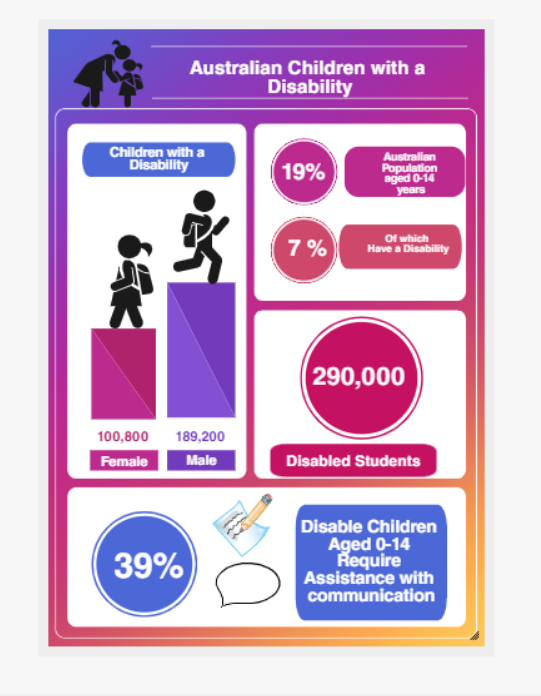
So, when I started to design my second infographic. This time I had my key message and the audience in mind. So, I set about to make sure my message was more apparent and was emphasised. I am happier with this infographic.

References:

Column Five (27th September, 2011). The Value of Data Visualisation. Retrieved 17th May 2019 from https://vimeo.com/29684853

Australian Bureau of Statistics (ABS).(2009). Disability, Australia, 2009. Retrieved 10th May 2019 from https://www.abs.gov.au/ausstats/abs@.nsf/mf/4446.0

Australian Curriculum Assessment and Reporting Authority (ACARA). (2017). Australian Curriculum: F-10 curriculum: Technologies: Digital Technologies. Retrieved 17th May 2019 from https://bit.ly/2z9PE7K

Technology Challenge 10 – Coding- Scratch it!

To be honest I was not looking forward to this challenge. Coding is something that is that I honestly thought I would not be able to do. I have a very talented brother who has been a computer programmer for many years. I know that he has experience in platforms such as Java and C+ and his University text books were enough to give me nightmares. So here it goes (with no help from my brother at all)…..

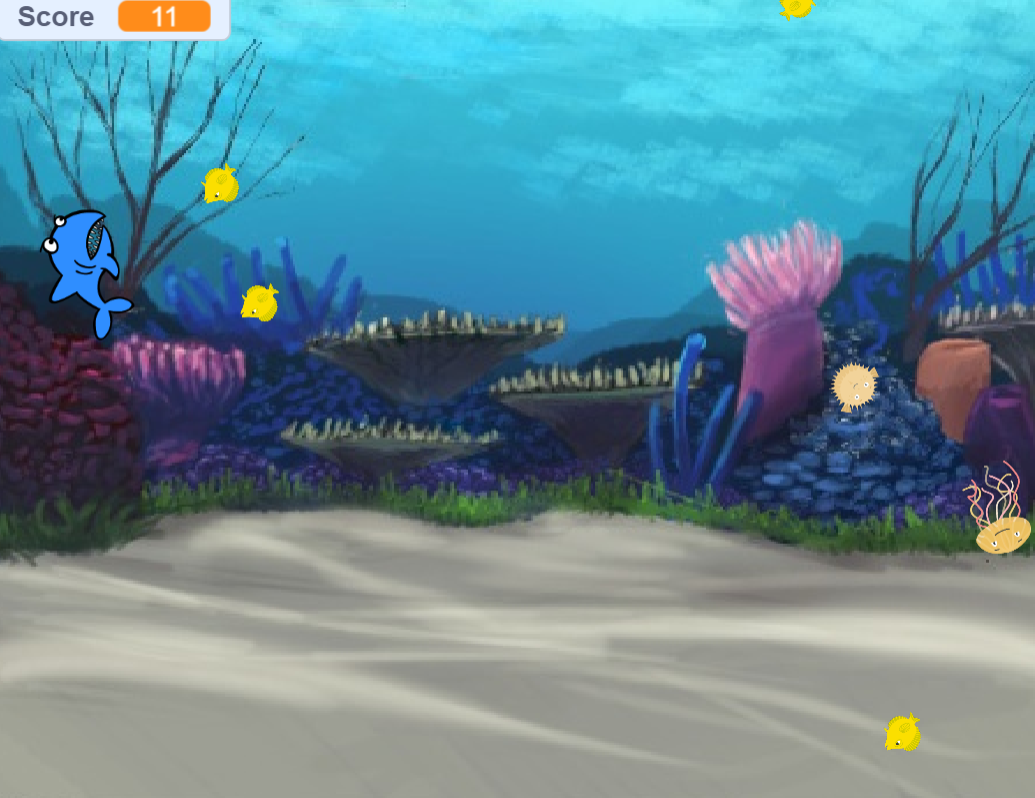
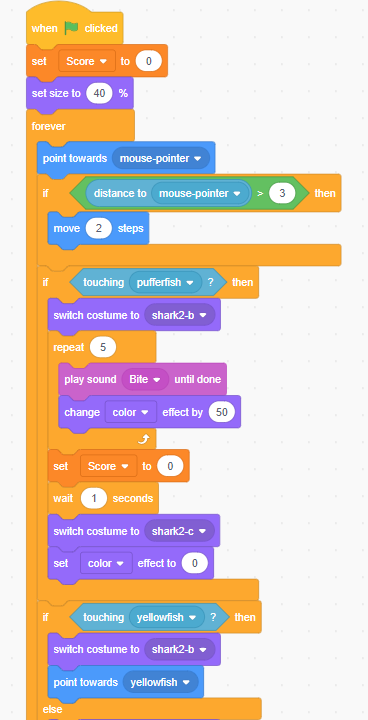
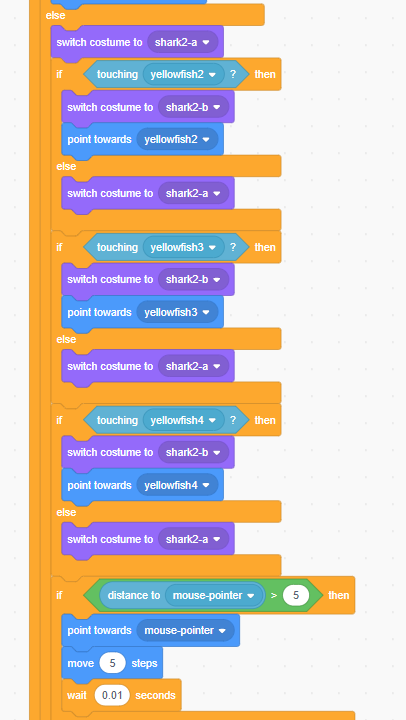
The Shark challenge: Well I started this process before the code instructions were updated. Hmm… I was thinking at times, this is not working. So, I left it and went back to it several times over and over again. Through lots of trial and error, I worked out how to make the variable and name it “score”. I have played around the program and have made some alterations to the original code. The best thing I discovered was that I could not break the computer, that it was okay to make mistakes, as you never know what you can learn by making mistakes. Please find below the link to my shark coding game.

https://scratch.mit.edu/projects/305601118/

Shark Game Coding Challenge

I have also loved playing around with the sprite’s costumes. This helps the designer (in this case me) target a specific audience.

I have also introduced a jelly fish that floats around (using a code that moves, waits and change direct) and changes colour if touched by the shark. When I first introduced movement to my jelly fish he was flying around the screen and bouncing off the walls like a bouncing ball. Not what I had in mind. However, by adapting the code and trial and error enabled me to slow down the movement to more drifting sequence. Challenge accepted and even though my code is not perfect, I am happy with the results.

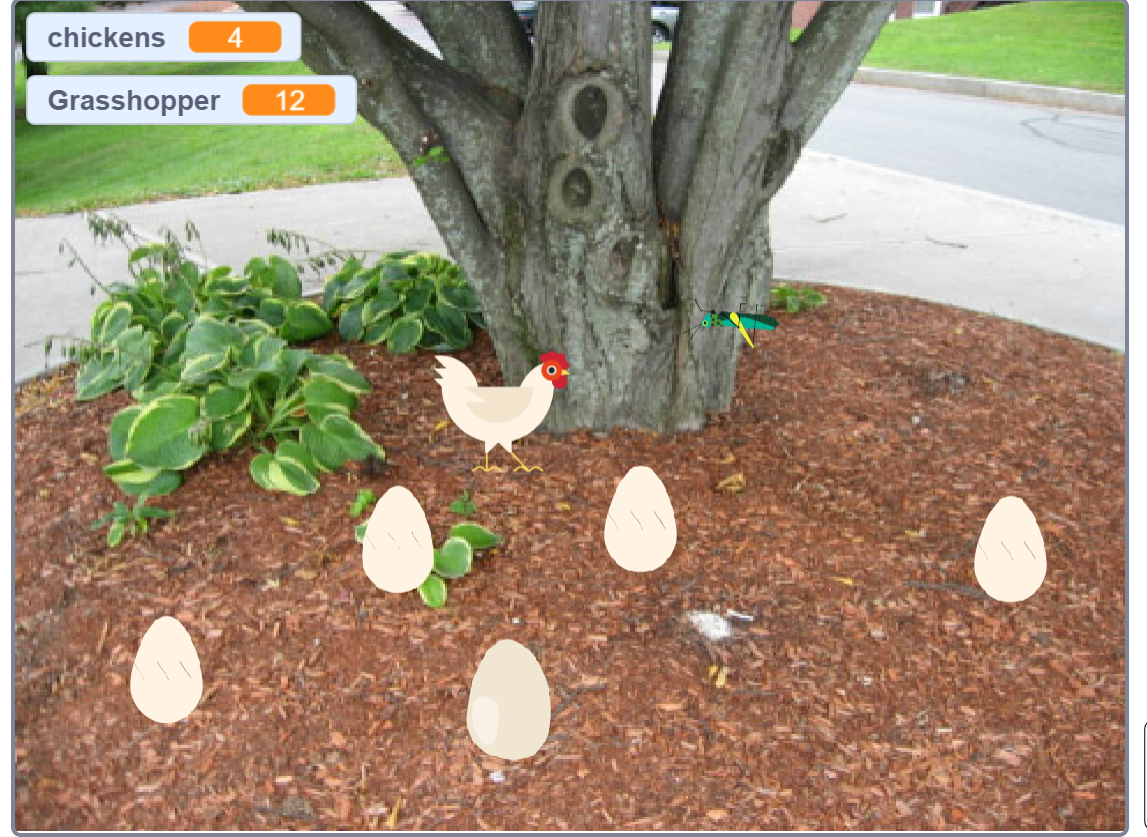
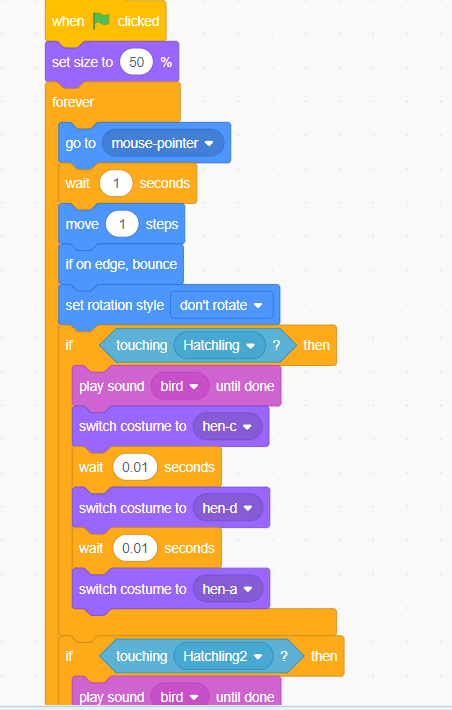
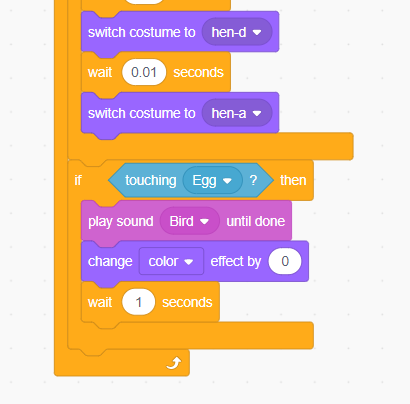
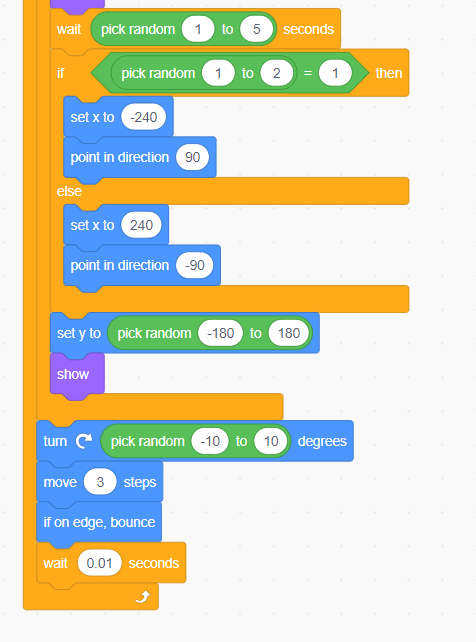
So after completing this challenge, I thought I would try my hand at a different code game. I started with a chicken and hatching eggs. I then added in a bad egg (that resets the score, little legs appear and a hmm speech bubble). I then add another variable a grasshopper. Please find below my link.

https://scratch.mit.edu/projects/305201505/

Code Game – Chicken and Eggs

I still would say that my code is not perfect, and there are areas that I could still improve on. However, at the start of this challenge I seriously questioned my ability to code. So if I can do it… anyone can.

I have had lots of fun experimenting with coding and have learnt a lot through trial and error. This highlights this exercise requires time, for students to explore and experiment, as well as for trial and error. I know that I was not able to get the coding right the first time, and I am now still going back to improve or add more to both coding game. I can see that students would be extremely engaged in the coding process and is fantastic for process to highlight computational thinking.

Cyber Safety

As with all activities in the classroom, safety is of paramount importance to our students, as teachers we have a duty of care (Australian Curriculum and Reporting Authority (ACARA), 2018). The use of computers in the classroom also highlight the need to teach students cyber-safety. It is of the utmost importance that they do not share their personal information online as it can be used for undesirable purposes. Students must fully understand the importance of strong passwords and keep it private, as it is a way to protect their identity. Also, how to behave whiles online by being kind and respectful. It is highly important that students are aware of how to use digital devices in a safe manner for their own protection. Below is great poster to remind students of these points and more about cyber safety by the Australian Government eSafety Commissioner. Other rich resources are available through their website on games and other resources to help teach cyber safety.

Cyber rules poster
Cyber Rules Poster

Teachers are also required through the Australian Professional Standards for Teachers as stated in Standard 4 to “Create and maintain supportive and safe learning environments”. Stardard 4.5 highlights the use of ICT safely, responsibly and ethically (AITSL, 2011).

Links to the Curriculum: Foundation to Year 2- Digital Technologies

Recognise and explore digital systems (hardware and software components) for a purpose (ACTDIK001). Students to learn that there are a wide variety of digital systems. For example a smartphone is a digital system that has software (apps), input components ( touch screen, keyboard, camera and microphone), output components (screen and speakers), memory components (silicon chips), communication components (SIM card, wi-fi, bluetooth).

Follow, describe and represent a sequence of steps and decisions (algorithms) needed to solve simple problems (ACTDIP004).

An algorithm is a computer procedure that is a lot like a recipe (called a procedure) and tells your computer precisely what steps to take to solve a problem or reach a goal.  Coding is a list of instructions given to a computer to do something. Scratch is a platform where students can learn to code to make simple computer games (Australian Government, 2017). Through coding students learn that there’s often more than one way to solve a problem. “Learning to code encourages children to become creators, not just consumers, of the technology they use” (Australian Government, 2017).

Explore how people safely use common information systems to meet information, communication and recreation needs (ACTDIP005). Cyber safety is an important aspect for all those who use digital technologies (refer above).

Create and organise ideas and information using information systems independently and with others, and share these with known people in safe online environments (ACTDIP006) It is important for students to be able to share ideas and information with others is a safe way (refer to cyber safety above).

Reflection on Completing All of the Technology Challenge

Wow, these challenges have tested me, firstly personally and then professionally as a teacher (how to make these exercises suitable for the classroom). Aspects of personal safety, design thinking, cyber safety are all important aspects to consider. I did find the challenges a great way to learn and grow my skills. The sense of achievement has been very rewarding. This is also a very important aspects for my students to feel and achieve. I have also learnt a lot of very valuable new skills. Thank you for this rewarding journey.

References:

Australian Curriculum Assessment and Reporting Authority (ACARA). (2018). Technologies: Digital Technologies: Foundation to Year 2. Retrieved 11th May 2019 from https://bit.ly/2z9PE7K

Australian Government. (n.d). eSafety Commissioner. Cyber Rules Poster. Retrieved 11th May 2019 from
https://www.esafety.gov.au/about-the-office/resource-centre/poster-cyber-rules

Australian Government. (2017). Learning potential. retrieved 15th May 2019 from
https://www.learningpotential.gov.au/

Australian Institute for Teaching & School Leadership (AITSL), (2017).  Australian
professional standards for teachers
.  Retrieved 11th May 2019, from https://www.aitsl.edu.au/teach/standards

Technology Challenge 8: Design Project – Ethics and Sustainability

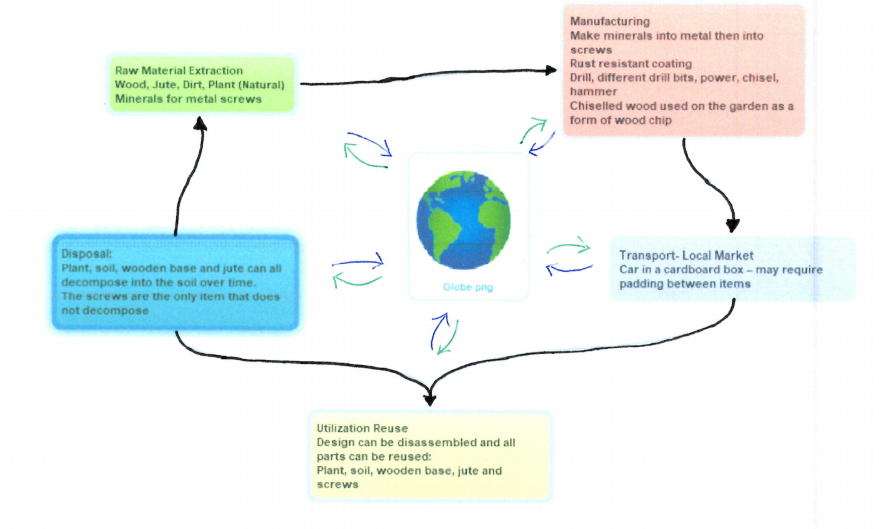
The Lifecycle of my Design:

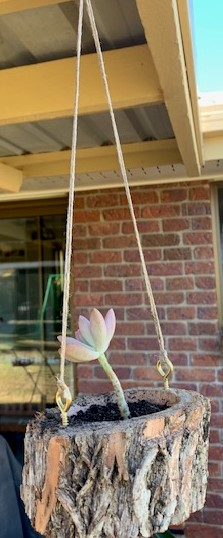
Design: Hanging Pot Plant made from a Wooden Round.

Considering the life cycle of my designed product: Hanging pot plant made from the wooden round.

->
Considering the lifecycle of my designed product. It has gone, and will go through a number of stages.

Most of the materials in my design are in their natural source or are originally from a natural source. Most of this design would decompose back into the environment over a short period of time. The only exception being the metal eyelet screws.

Natural organic material: reclaimed wood (wooden round), soil, plant.

Originating from a natural resource: jute cord, metal (formed from minerals).

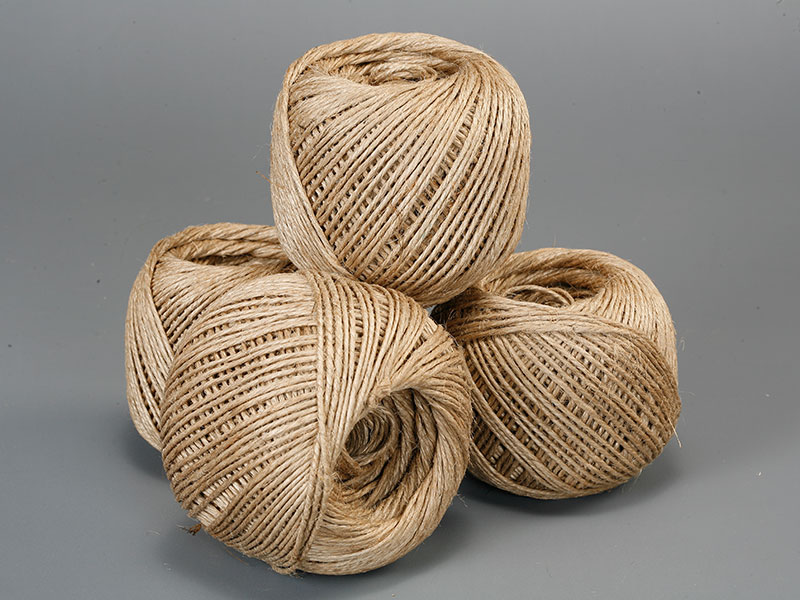
As I was unaware of the properties of jute other than it was a plant-based source, so I endeavoured to discover more information.

Related image
Jute
(JM, 2016).  

What is Jute?

  • Jute is a rain-fed crop with little need for fertiliser or pesticides.
  • Jute fibre is 100% bio-degradable and recyclable and thus environmentally friendly.
  • It is a natural fibre with golden and silky shine and hence called The Golden Fibre.
  • Advantages of jute include excellent insulating and anti-static properties, as well as having low thermal conductivity and moderate moisture regain.
  • Disadvantages include poor drapability and crease resistance, brittleness, fibre shedding, and yellowing in sunlight. Jute has decreased strength when wet.
    (FAO, 2019)   

Macramé is a cord that can be made from a variety of materials such as cotton, wool, linen, hemp, jute, leather or yarn. The cord is identified by construction, for example, a
3-ply cord is made by three lengths of fibre twisted together. Once again, all of these materials are natural.

The hanging pot plant can be disassembled and the components can either decompose or in the case of the metal screws be re-purposed.

I found this an interesting exercise, and I have learnt a lot by investigating the sustainability of any design. This process has enabled me to look at the design and its components through different filters (raw materials, manufacturing, transport, utilisation/reuse and to disposal).

Risk Assessment of Design Product

Related image
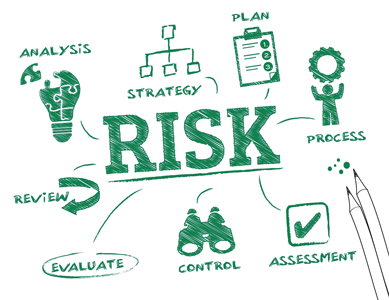
(European Health & Safety Consultants LTD. ND)

By making the design prototype, it was evident that the removing of the centre of the wooden round is an activity that is much too risky for students to do. This is because the likelihood and the consequences of an accident causing bodily harm are too high, making this design project too risky.

So to make this design project safe for a year two classroom, the design of the wooden base has been modified to use recycled pallets which are then glued and reinforced by hammering nails into the corners.

When undertaking such a project such as this, all risks must be considered. All appropriate safety equipment (safety goggles, paint shirts, suitable shoes) must be used correctly at all times. Additional adult supervisions (i.e. Teacher aid, Volunteers with Blue card/parents) would be required to complete this task successfully. Close supervision and a higher ratio of adult to participant would be required when using hammers to ensure safety. All steps would be clearly set out with the use of laminated posters, and teachers would model the process for students to follow to ensure safety.

Please refer to the CARA risk assessment link below for this Design Project.

By completing the risk assessment on my design project highlighted many risks associated with completing a design project and making it safe for the classroom. There were many aspects I needed to take into consideration to ensure the safety of the participants at all time and reduce potential risks. These included the ratio of suitable supervisors to participants, ensuring that each process was safe, engaging and achievable for the participants and ensuring the correct use of safety equipment.

References:

European Health & Safety Consultants Ltd. (N.D). General Risk Assessment. Retrieved 26th April 2019 from
https://www.ehsc.co.uk/our-services/general-risk-assessment/

Food and Agriculture Organization of the United States (FAO). (2019). Future Fibres- Jute.  Retrieved 22nd May 2019 from  http://www.fao.org/economic/futurefibres/fibres/jute/en/

Jaikshandass Mall Jute Products (P) Ltd (JM). (2016). Polished Jute Twine.  Retrieved 22nd May 2019 from  https://www.jmjute.com/polished-jute-twine.html

Queensland Government: Department of Education. (2nd October 2018). Curriculum Activity Risk Management Guidelines. Retrieved 26th April 2019 from
https://education.qld.gov.au/curriculum/school-curriculum/CARA

Queensland Government: Department of Education. (2nd October 2018). Screwdrivers: Safe Operating and Procedures. Retrieved 26th April 2019 from
https://education.qld.gov.au/initiativesstrategies/Documents/sop-ht-screwdrivers.DOCX

Queensland Government: Department of Education. (2nd October 2018). Hammers and mallets: Safe Operating and Procedures. Retrieved 26th April 2019 from https://education.qld.gov.au/initiativesstrategies/Documents/s op-ht-hammers-and-mallets.DOCX

Challenge 4 – Drama, Media Arts

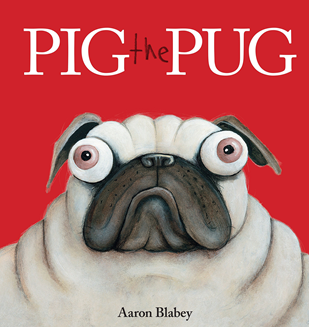
Pig the Pug

By Aaron Blabey

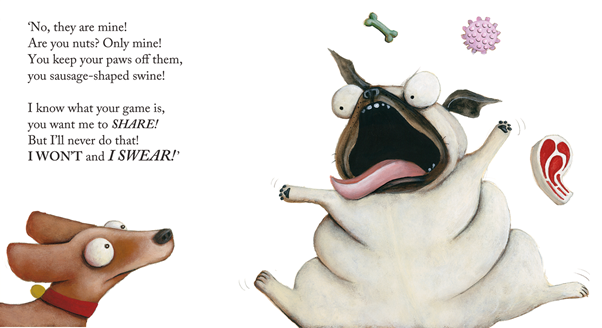
I choose a favourite children’s book, Pig the Pug by Aaron Blabey.  The story follows a day in the life of Pig (who is a rather selfish pug) and his play time with Trevor the sausage dog.  All Trevor wants is one toy, but Pig refuses to share. As a poor Trevor’s luck would have it, Pig goes into a toy-snatching frenzy and makes a rather large pile of toys. In his blind selfishness, Pig gets what’s coming to him.

This book is a great way to introduce the different types of emotions through the two characters Pig and Trevor. The humours facial expression on the two dogs make the story engaging. I would read aloud this book to the class.

I then used Voki to create a digital avatar, and used my own voice (a gruff voice) to represent Pig.   The only thing lacking was the great facial expression that make the book Pig the Pug such an engaging story.

Please find my link to my version of Pig the Pug on Voki.

http://tinyurl.com/yxmwyyz7

This book as a gateway into exploring the different emotions of the students. How do you think Pig would be feeling here?  Why?  (Using facial expressions, stance, movement and direct speech as indicators). What about Trevor?  How do you think he will be feeling when Pig takes all the toys? Students are to as a group explore different emotions with their facial expressions, body language, movement, and voice.

  • How do we show anger is our face? In our stance? In our movement? In our voice?
  • How do we show happiness in our face? In our stance? In our movement? In our voice?
  • How do we show sadness in our face? In our stance? In our movement? In our voice?

The aim of this exercise is to:

  • Explore student’s emotional and social understandings, how they feel and express emotions through their face, body language, movement and voice.
  • Build empathy and social skills as children recognise and respond to other people’s emotions and feelings;
  • Develop children’s capacity to represent human emotions and feelings through drama.

Then students would take turns at a hot seat role playing the two charters Pig and Trevor.  Hot Seating is a strategy in which characters, played by the teacher or a student, are interviewed by the rest of the class.  This activity invites students to recount the events in the book, explore motivation and two perspectives highlighted in the book.  In this case students are told that a detective has come to investigate, as someone said that Pig was pushed out the window, not fell. 

It is important to first prepare the student/s who will be in the hot seat to successfully take on their role, in this case there are two main characters, Pig and Trevor (Neelands and Goode, 2019). The teacher/student in the hot seat needs to determine who they are in the interview, where they are, and why they are in the hot seat. The students (audience) not in the hot seat can take turns asking questions. These student’s may need support to prepare questions from their personal view point to ask the character in the hot seat. 

The aim is for students to deepen their critical thinking about the characters, including their emotions, thoughts and motivations. Students are to remain in character whilst they are in the hot seat.

This fits well into the Australian Curriculum for Foundation to Year 2: Drama:

Content Description: Use voice, facial expression, movement and space to imagine and establish role and situation (ACADRM028)

  • communicating verbally by using the voice to explore and show role and situation
  • communicating non-verbally by using facial expression and movement to explore and show role and situation
  • practising movement within a space to create the difference between their performance space and the audience space

References:

 Australian Curriculum Assessment and Reporting Authority (ACARA). (2018). The Arts: Drama.  Retrieved 5th April 2019 from https://www.australiancurriculum.edu.au/f-10-curriculum/the-arts/drama/

Oddcast. (2019). Voki.  Retrieved 5th April 2019 from https://www.voki.com/

Challenge 3- Digital Storytelling

My aim was to make a digital story about my daughter Jasmine. Jasmine has changed my world due to the challenges she faces everyday as a child with a disability. I have discovered that having a child that has several diagnosis and challenges in daily life has changed my perspective in this world. The aim of my digital story was for people to look past the diagnosis and the equipment they require to function, and focus on the person. Jasmine is not a Special Needs Child, but a Special child with needs. See the person not the disability.

I did find this challenge challenging, yet rewarding. I had over the years many photos of Jasmine. I was however had to ensure that no other person was visible in the photos I used (as I had not gained their permission). The focus was to focus on the person, so the type of shot used was close ups. The close up keeps only the face full in the frame. It is, without a doubt, the most important shot type to show dramatic elements, reactions, or emotion, which was my aim. I found the adding of text an issue, as the text was important to portray the message. Therefore using the white board with black text highlighted a point of difference. Using also handwriting gave a feeling of being raw. I use the soundtrack to also emphasise the message of the story. I used a lot of close up shots and pace to emotional engage the viewer into seeing a child, not the disability.

This challenge was very emotional for me, as the subject is very close to my heart. However I felt like it was time for me to open up for the benefit of my daughter and all others who have a disability.

Jasmine Lane… This is me!!!

Challenge 2 – Same, Same but different

Same, Same but different- Explore three ways

This week I focused on landscapes.  Once again using on my surname Lane, with each artwork to depict a Laneway. The thought behind this challenge is my personal journey through life. The laneway of my life has not always be bright and cheerful and a straight clear road.  Through my life there has been many cross roads, hard decisions and hard times.

My first drawing was influenced by Vincent Van Gough early pieces, where he showed a fascination for the creepy, eerie forms seen in some old trees. he seems to be exploring the trees form, which is heightened by their bleak and barren background (The Eclectic Light Company, 12th November 2015).

Vincent van Gogh (1853–1890), Tree roots in a Sandy Ground (‘Les racines’) (1882), drawing, 51.5 × 70.7 cm, Kröller-Müller Museum, Otterlo. Wikimedia Commons.

My second piece was influenced by both the cubism style of by Georges Braque and the landscapes that are simple and rich in coloured of Ted Harrison’s.

Houses at IÉstaque – Cubist Landscape by Georges Braque.

The cubism movement in art began in France in 1907 that is characterised by the use of geometric planes and shapes. The consist of interlocking shapes and geometric planes are examples of cubism.   This painting prompted art critic Louis Vauxcelles to mock it as being composed of cubes which led to the name of the movement (Chilvers and Glaves-Smith, 2009).  Cubism marked a major turning point in the whole evolution of modernist art. Above is an excellent example of cubism by Georges Braque.

Let’s Hurry Home, 1988 by Ted Harrison.

Ted Harrison’s style of the landscape is simple and rich in colours. Ted’s art depicts beautiful nature to make it look colourful and vibrant. The use of vibrant balanced colours aim to take the viewer to a world of happiness and joy (Lil Creative Kids, August 9, 2016). The paint is flat and plain. This is a technique that I have personally not mastered.

The third piece was influenced by David Hockney and Grace Cossington Smith.

David Hockney’s Late Spring Tunnel, May 2006

Hockney paints each scene in vivid colours: spring dominated by the season’s abundant greens and yellows. Hockney’s demonstrates his fascination with examining the same place at different times of the day and the year (Curiator, 2016). Relevant for this challenge same, yet different. I like how he used in this painting the different tones of the same colour to highlight details and how the road is the focus of the painting.

Near Exeter, 1947 by Grace Cossington Smith.

Grace Cossington Smith was an Australian artist and pioneer of modernist painting in Australia and was instrumental in introducing Post-Impressionism (Hart, 2005).  This painting show the olive green and sienna colours of the Australian bush, depicted in a style where the brush strokes are visible, made up of many similar colours. I have tried to consider the use of blending shades of colour to add depth, detail and texture like that displayed in the above painting. 

Number 1: Lead Drawing

Which Way to Go?

This drawing is to symbolise some of the hard decisions in my life during some dark times. I have tried to bring in the eerier and creepy elements in Vincent van Gogh’s earlier pieces by experimenting with the dramatic effect and contrast of the black on white and all the shades of grey.  I focused on capturing shadows and have even tried to make the shadow of the tree to depict a hand reaching out over the ground and over the pathway.  The mountain and the rocks are close to the road.

On reflecting on this drawing, it is important for me to recognise the past, as it has helped to shape the person I am today.

Number 2: Painting

The Two Sides of the Lane

My 2nd piece is a painting and experimenting using cubist landscape on one side and a a simple almost childlike version on the other side. The idea of this piece (which I don’t think is clearly highlighted) is that anyone journey can be both jaggered and forever changing or smooth and straight. Both are part of the same road, it all depends on how you look at life and at times things outside of ones control. The cool colours are the mountains and grass and the warm colour is the laneway and the sun.
I experimented with cubism on one side of the painting, and aimed to contrast with smooth and simple on the other. However, I don’t think this was effective. My 6-year-old daughter told me that my painting is of a volcano. I can see why she thinks this. I need to practice my painting skills.

Number 3: Coloured Drawing

The Yellow Brick Lane

The aim of this drawing was to contrast with the first piece. Instead of dark, this pictures aim was to be bright and cheerful. The laneway is coloured like the yellow brick road, or the golden path. This is to represent a course of action taken believing that it will lead to good things.
The mountains are in the background far away. The road is clear heading in the one direction. The trees are alive and full of life, with a wispy non-threatening shadow. A chair waits for a passer-by to take time to rest. I have focused on trying to blend different colours to give texture and more detail to the tree trunk, the mountain and int bright green grass.

References:
Chilvers, Ian; Glaves-Smith, John. (2009). A Dictionary of Modern and Contemporary Art. Oxford University Press.
Curiator. (13th August, 2016). Late Spring Tunnel, May 2006 by David Hockney. Retrieved 27th March 2019 from: https://curiator.com/art/david-hockney/late-spring-tunnel-may-2006
James, B., Grace Cossington Smith, Craftsman House, Sydney, 1990, p. 111.

Hart, D. (2005). Grace Cossington Smith, National Gallery of Australia, Canberra.
The Eclectic Light Company. (12th November, 2015). Trees in the landscape: 5. Vincent van Gogh and swirling cypresses. Retrieved 26th March 2019 from https://eclecticlight.co/2015/11/12/trees-in-the-landscape-5-vincent-van-gogh-and-swirling-cypresses/

Lil Creative Kids. (August 9, 2016). Ted Harrison’s Style of Landscape. Retrieved 26th March 2019 from: http://www.lilcreativekids.com/ted-harrisons-style-landscape/